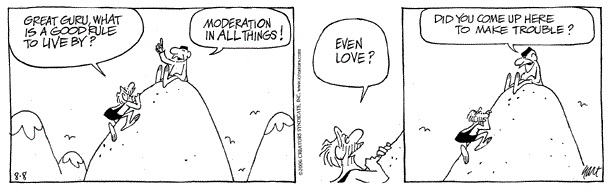
It’s been awhile since I’ve done a Radical Moderate post, and in these extremely polarized times maybe it’s not a good idea to revive my practice of spouting off about some political issue that bothers me. But today, in Dungeon’s and Dragons terms, I failed my Wisdom Check.
So . . . let’s talk about demonstrations and protests, a fine American tradition.
In the bad old days, the days of monarchies and less-than-liberal republics, the government considered open demonstration against its leaders or their chosen policies to be a form of treason. That being so, they maintained a sort of “balance of terror” with their subjects; the occasional protest gathering outside a government palace or administrative building was one thing. But if it grew too big, stayed too long, or got too rowdy (as defined by their rulers), their rulers would send out cavalry soldiers with an officer who would proclaim the gathering “in defiance of the state” and command the protestors to disperse. If they didn’t then disperse quickly enough, the soldiers would disperse them with their sabers.
This common response to protest, practiced even in England at the time of the American Revolution (although king and parliament were notably less quick to practice it than their continental peers), was resorted to a few times in the British Colonies. Strong memories of this shaped the thoughts of the first congress that met under the United States Constitution to, among other tasks, frame the promised Bill of Rights. It is the reason for the last two clauses in our Freedom of Speech amendment:
Congress shall make no law respecting an establishment of religion, or prohibiting the free exercise thereof; or abridging the freedom of speech, or of the press; or the right of the people peaceably to assemble, and to petition the Government for a redress of grievances.
A couple of generations later, the purpose of the clauses was reaffirmed in a Supreme Court decision:
The right of the people peaceably to assemble for the purpose of petitioning Congress for a redress of grievances, or for anything else connected with the powers or duties of the National Government, is an
attribute of national citizenship, and, as such, under protection of, and guaranteed by, the United States. The very idea of a government, republican in form, implies a right on the part of its citizens to meet
peaceably for consultation in respect to public affairs and to petition for a redress of grievances.
A later decision clarified that the right to assemble covered freedom of assembly covered all public forums, like streets and parks. All this is the basis for our laws regarding the regulation of protests today; the government has not right to make laws abridging our right to assemble in public to demonstrate and protest.
And this is a good thing, while the rights enshrined in the First Amendment stand, the republic stands.
However.
In light of current events (in 2016, 2020, 2023-24 . . . ) I think it’s important to draw attention to the fact that we’ve sort of lost sight of a very important word in the Freedom of Assembly clause; peaceably. To peaceably assemble. What does to assemble peaceably mean? What it doesn’t mean is to ask for permission first. The authorities are the ones being protested against; requiring their permission to protest would be counterintuitive to say the least. It would nullify the right, making it a government-granted privilege.
What it does mean is that for assemblies to be lawful they must be peaceful in the real sense of the word; free of civil disturbance, disorder, turbulence, violence. They cannot involve force. When they take place in a public forum they cannot be conducted in a way that impedes everyone’s use of that public forum. Protestors can protest in front of a public building, but may not block access to and use of that building; this applies even more so for private buildings like businesses and residences. Protestors may certainly not block sidewalks and roads, which are for general public use. Marches require permission and licenses because police must be prepared to guard the route, regulating traffic around the march. And certainly if elements of a protest become disorderly or violent (engaging in vandalism, heated altercations, etc.) authorities are empowered to preserve the peace by shutting demonstrations down.
This used to be understood; once upon a time, a demonstration that formed to block traffic and pedestrian passage was considered to be un-peaceful since it involved force, even if a sort of passive force. Yes, a bunch of protestors linking arms and daring anyone to try and break their lines are exercising force, whether they’re doing it in front of a building, on a street, or on a freeway, and are most appropriately responded to by police who use sufficient force to break those lines and arrest the protestors on civil disturbance charges, restoring public use of the public forum.
Freedom of assembly does not allow protestors to deprive fellow citizens of their free use of public forums.
Additionally, protest speech is circumscribed by law. Assembled protestors have no more right to commit assault—act or speak in a manner which causes someone to fear imminent violence—than any private citizen does. But so long as citizen-assemblies are peaceable, the government cannot shut them out of any public forums. And this is a good thing; protests and demonstrations can be annoying but giving government the power to regulate time and place in public forums would, again, reduce the right to a government-granted privilege.
Which doesn’t mean protesters can assemble anywhere. Outside of public forums there are two other classes of forum; limited public forums and private forums. Limited public forums are government buildings open to citizen access, such as public libraries and theaters or university buildings and public spaces in government office buildings. Governments may limit access to such spaces for purposes of free assembly, but only in ways that are non-discriminatory. For example, a public theater couldn’t refuse to host a conference or a public library a lecture in one of their lecture halls because they don’t like the politics of the speakers. Certainly governments and government-affiliated entities like public universities may decide not to allow types of free assembly that interfere with the intended use of those spaces, such as classes, performances, or government business.
And private forums are even more restrictive; they are private property, and the property owners or administrators may do whatever they wish regarding acts of speech and free assembly, peaceable or otherwise. Note that this right to enjoy the use of one’s property undisturbed by protestors extends beyond the boundaries of such private forums (and limited public forums); a protest conducted at night in a residential neighborhood, at volume sufficient to keep residents from sleeping in their homes, is lawfully considered a civil disturbance and not peaceful. Protests conducted outside university buildings at such volume as to prevent occupants of said buildings from conducting classes, hearing speakers, etc., are not peaceful (in addition to depriving someone of their right to speak and their audience of their right to hear that speech). Nor are protests that block access to speech they don’t wish others to hear.
Now, all of these details will sound like common sense to most. But what about causes that seem to cry out for protest above and beyond the “orderly” forms of assembly that the law protects? The anti-Trump protestors in 2016, Black Lives Matter protestors in 2020, the Jan. 6 capitol rioters, and pro-Palestine protestors today, felt impelled by conscience to go beyond peaceable assembly. Many, although not a majority, committing acts of civil disobedience and even violence against property and persons. Less extreme demonstrators have taken over public and limited public forums, committing acts of passive resistance (still involving force). What should be the public response here? Especially when you might sympathize with their goals?
Thinking about it reminded me of a conversation in a science-fiction story:
First speaker: “Rules were meant to be broken.”
Second speaker: “I don’t disagree, indeed they are. Providing, however, that the one breaking the rules is willing to pay the price for it, and the price gets charged in full. Otherwise, breaking rules becomes the province of brats instead of heroes. The fastest way I can think of to turn serious political affairs into a playpen. A civilized society needs a conscience, and conscience can’t be developed without martyrs—real ones—against which a nation can measure its crimes and sins.” (From Crown of Slaves by David Weber & Eric Flint)
Suffragettes committed acts of public disorder knowing they’d be arrested and jailed, and went willingly knowing that their voluntary suffering under the law would speak to their cause. And it did. University students taking over a quad and then a university building, then complaining when they’re arrested or even just suspended or expelled for it, aren’t heroes or martyrs; they’re cosplayers.
If your cause is just, fit your actions to it and then stand by your actions, ready to take the punishment the republic has prescribed while your fellow citizens judge the justice of your cause and the rightness of your acts.
In a free republic, it’s the only way.
MGH
 Marion G. Harmon, A Writer in Vegas.
Very good.
Blocking streets is felony false imprisonment. It’s also reckless endangerment because it’s impossible to clear up the consequences quickly enough to avoid slowing down an ambulance.
http://www.avg.com/email-signature?utm_medium=email&utm_source=link&utm_campaign=sig-email&utm_content=webmail Virus-free.www.avg.com http://www.avg.com/email-signature?utm_medium=email&utm_source=link&utm_campaign=sig-email&utm_content=webmail <#DAB4FAD8-2DD7-40BB-A1B8-4E2AA1F9FDF2>
I wasn’t aware the penalties were so high for blocking traffic, good to know!
Assuming they are arrested and prosecuted. . . .
Would you care to share any thoughts about Project 2025? It would, among many, many other things, affect how protest is dealt with.
I have no thoughts about Project 2025. I’m only aware enough of it to know it’s one of a basket of conservative political reform movements, and from what I’ve read of it all that I can say is I agree with some of its policy recommendations, disagree with others.